AI Store Associate Copilot: Retail Staff Productivity Guide
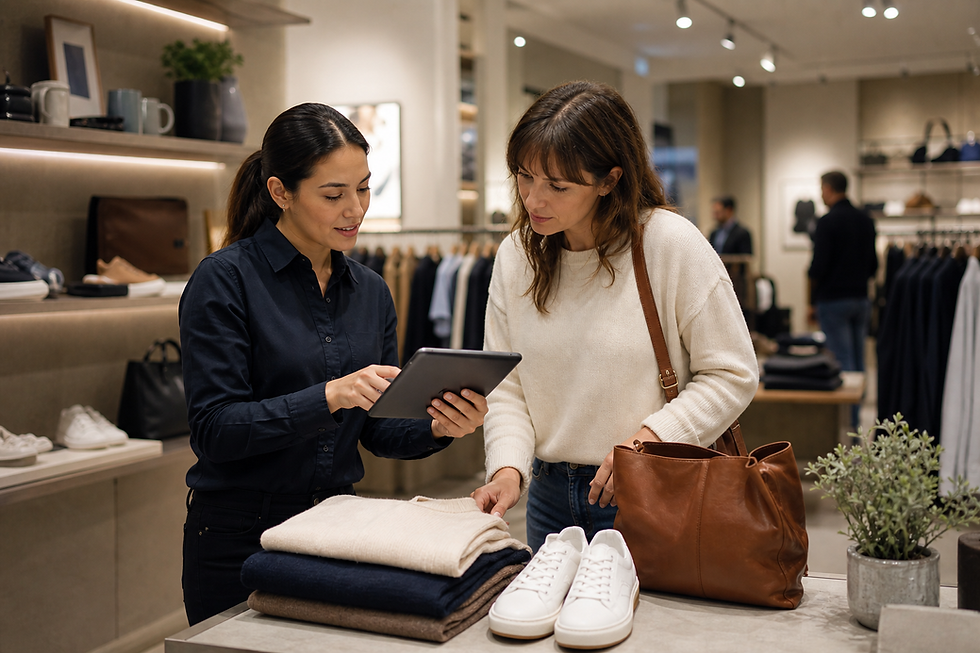
How can an AI store associate copilot help retail teams sell with more confidence, answer faster, and keep service personal on a busy store floor?
An AI store associate copilot is a practical layer of retail intelligence that helps team members answer product, inventory, customer, and service questions in the moment. It does not replace the human associate. It gives that associate sharper context, faster access to information, and more consistent guidance when the shopper is already standing in front of them.
For Mimic Retail, this topic fits naturally beside AI shopping assistants, smart retail solutions, and retail experience orchestration. The difference is the focus: this article looks at the associate workflow, not only the shopper interface.
Table of Contents
What is an AI store associate copilot?

An AI store associate copilot is a digital assistant built for retail staff. It sits inside the tools associates already use, such as tablets, mobile devices, kiosks, clienteling apps, POS-adjacent workflows, or back-office dashboards. Its job is to bring together product knowledge, availability, shopper context, service policies, and next-best action guidance in a form that staff can use while serving customers.
The best version of this tool is not a generic chatbot. It is a controlled retail interface connected to approved product data, brand language, stock visibility, merchandising priorities, and escalation rules. When a shopper asks which item is better for travel, whether another size is available, or what completes a look, the associate should not have to search five systems or rely only on memory.
This extends the thinking behind artificial intelligence in retail stores for staff productivity. Productivity matters, but the bigger opportunity is service quality. The copilot gives the associate a stronger answer at the precise moment when the shopper is deciding whether to trust the brand.
A useful copilot can summarize product differences, suggest discovery questions, surface relevant alternatives, explain compatibility, check store or nearby availability, prepare a handoff to another channel, and capture learnings from repeated shopper questions. The result is not just faster service. It is a more confident retail conversation.
Why store associates need better context

Retail associates often operate with less context than the ecommerce site. Online, a shopper may see recommendations, reviews, availability, product comparisons, rich imagery, and saved browsing history. In store, the associate may only see the product in front of them and whatever details they can remember. That gap creates inconsistent service.
The context problem becomes more visible as assortments grow, channels multiply, and shoppers arrive with research already done. A customer may have seen an item on social media, compared it online, checked a competitor, explored a virtual shopping experience, and then entered the store expecting the associate to understand the whole journey.
Mimic Retail's work around phygital retail experience design points to the same issue: digital and physical touchpoints need to reinforce each other. If store staff cannot access the signals created by digital discovery, the brand loses continuity at the highest-intent moment.
Product context: materials, sizes, variants, care guidance, compatibility, bundles, and alternatives.
Operational context: stock, nearby store availability, delivery options, appointments, and service policies.
Shopper context: stated needs, saved preferences, viewed products, consented clienteling notes, and previous questions.
Guided selling and product discovery

Guided selling is where an AI store associate copilot can quickly prove value. Many shoppers do not need a hard sell. They need help choosing. They want a clear comparison, a confidence check, or a recommendation that reflects their use case instead of a generic top seller.
A copilot can prompt the associate with useful discovery questions: Who is this for? Where will it be used? What matters most: fit, durability, style, budget, delivery speed, or compatibility? The associate can stay present with the shopper while the system helps structure the conversation.
This connects well with visual search in retail and 3D product visualization. If the shopper starts from an image or needs visual proof, the copilot can move from explanation to demonstration: show comparable items, surface a 3D view, or help the associate explain scale, fit, or styling.
The strongest guided selling experiences feel human, not automated. The associate remains the host of the interaction. AI supplies comparison logic, product memory, and next-best options. This keeps the service personal while reducing the cognitive load on staff.
Inventory answers and real-time store intelligence

Store associates are often judged by how fast they can answer operational questions: Is it in stock? Is there another size nearby? Can it be delivered? Is this compatible with what I bought before? What happens if I return it? These questions decide whether a shopper keeps moving.
An AI copilot becomes valuable when it is connected to real-time store intelligence. It should know which information is approved, which systems are authoritative, and when the answer needs a human confirmation. A confident answer is only useful if it reflects current operational reality.
That is why the copilot should sit on top of the same real-time thinking described in smart retail solutions for real-time store intelligence. AI can explain, summarize, and recommend, but the operating layer must keep it grounded in inventory, store status, product rules, and shopper permissions.
This also helps managers. The copilot can reveal patterns: repeated stock questions, unclear product attributes, store zones that trigger service delays, and moments where staff frequently escalate. Useful metrics include time to answer, stock lookup completion, alternative recommendation acceptance, associate confidence, avoided handoffs, customer satisfaction, conversion after assisted discovery, and reduction in return-driving misunderstandings.
Training, coaching, and repeatable service quality

Retail training often happens before the associate is under pressure. Real service moments are messier. Shoppers ask unusual questions, products change, inventory shifts, and seasonal campaigns introduce new priorities. A copilot can become a living coaching layer that supports the associate while the work is happening.
For new team members, the copilot can provide approved phrasing, product comparison summaries, service-policy reminders, and questions to ask before recommending an item. For experienced associates, it can speed up edge cases, surface cross-sell ideas, and capture recurring questions that should become future training modules.
The goal is repeatable service quality without flattening the personality of the associate. Staff should still bring empathy, judgment, and human presence. The copilot simply reduces the amount of information they need to memorize and helps them respond consistently across stores.
Implementation roadmap for retail teams

Retail teams should not start with a broad AI mandate. They should start with a clear associate workflow where better context will change measurable outcomes. Good first candidates include guided selling for high-consideration products, inventory and availability answers, assisted product comparison, onboarding for new staff, and service handoffs between online and store channels.
The roadmap should begin with the data foundation. Product attributes, media assets, store inventory, policy content, service rules, and analytics events need enough structure for the copilot to retrieve and explain them reliably. If the data is messy, AI will simply make the mess sound more fluent.
Next, connect the copilot to the broader experience layer. Mimic Retail's technology capabilities and services are built around the same principle: AI, 3D assets, virtual stores, and real-time intelligence should support one measurable shopper journey.
Pilot one workflow in one category or store format before expanding.
Use approved product and policy sources rather than open-ended answers.
Measure associate confidence and shopper task completion, not only usage.
Capture recurring questions and turn them into better content, training, and merchandising.
FAQ
What is an AI store associate copilot?
It is a staff-facing AI assistant that helps retail associates answer product, inventory, service, and shopper questions in real time using approved brand and operational data.
How is it different from an AI shopping assistant?
An AI shopping assistant usually serves the shopper directly. An associate copilot supports staff, helping them give faster, more consistent, and better-context answers during human service moments.
Can an AI copilot replace store associates?
No. The best use case is augmentation. The associate keeps the human relationship, judgment, and empathy, while AI supplies product memory, operational context, and structured guidance.
What data does a retail associate copilot need?
It needs clean product attributes, inventory visibility, policy content, store rules, media assets, customer permissions, clienteling context, and analytics events tied to shopper tasks.
Which retail use case should teams pilot first?
Start with one measurable workflow such as guided selling, inventory lookup, product comparison, associate onboarding, or online-to-store handoff for a high-consideration category.
How can retailers measure success?
Track time to answer, assisted conversion, stock lookup completion, associate confidence, shopper satisfaction, handoff quality, return reasons, and recurring questions that become training or content improvements.
Does the copilot need 3D or immersive content?
Not always, but 3D product visualization and virtual store assets make guidance stronger when shoppers need to understand fit, scale, styling, bundles, or spatial context.
What risks should retailers manage?
Retailers should manage incorrect claims, stale inventory, privacy issues, biased recommendations, overreliance by staff, unclear escalations, and outputs that conflict with approved brand or policy language.
How does this support omnichannel retail?
It preserves useful context between online discovery, virtual shopping, in-store service, inventory decisions, and post-purchase support so the shopper does not have to restart the journey.
Conclusion
An AI store associate copilot is one of the most practical ways to bring retail AI onto the floor. It helps teams answer faster, sell with more confidence, train more consistently, and connect digital discovery with human service. The value comes from context: product context, shopper context, inventory context, and brand-approved guidance at the point of decision.
Retailers that treat the copilot as part of a broader experience layer will get more from it. When AI connects to visual search, 3D product assets, real-time store intelligence, and service workflows, it becomes more than a staff productivity tool. It becomes a way to make every shopper conversation clearer and more measurable.
Mimic Retail helps brands design AI-powered, immersive retail experiences that support shoppers and store teams together. Explore Mimic Retail services, review the technology capabilities, or contact the team to plan an associate workflow that AI can support and your stores can measure.


Comments