Generative AI in Retail: Practical Guide for Immersive Commerce

How can generative AI in retail move beyond chatbots and become a useful layer for product discovery, immersive commerce, and store teams?
Generative AI in retail is becoming more than a content tool or a customer service experiment. Used well, it can interpret shopper intent, generate helpful product context, guide customers through complex choices, connect 3D and virtual store experiences, and give retail teams better signals about what shoppers actually need next.
For Mimic Retail, the opportunity is not to bolt AI onto a store as a novelty. The stronger approach is to design AI, immersive media, virtual shopping, and real-time intelligence as one experience layer. That is how retailers turn inspiration into confidence, confidence into action, and action into measurable business outcomes.
Table of Contents
What generative AI in retail means now
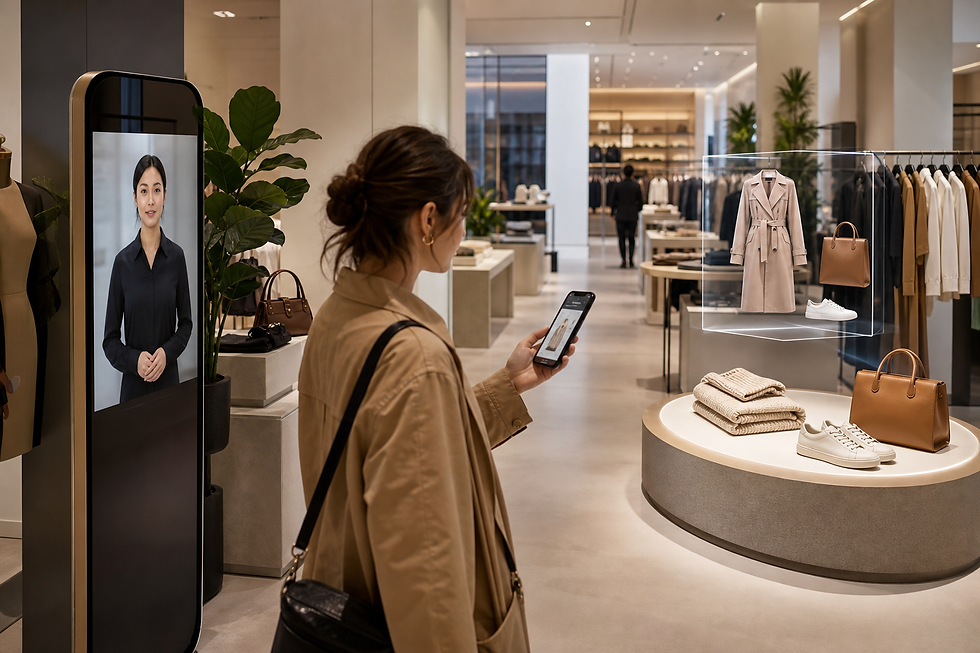
Generative AI in retail now means a system that can create, interpret, explain, and coordinate. It can produce product descriptions, but the bigger value appears when it understands shopper intent and uses that intent to guide decisions across channels. A shopper may begin with a vague request, an image, a style reference, or a problem to solve. AI can translate that signal into product options, comparison logic, fit guidance, and a useful next action.
This matters because modern retail journeys are no longer linear. Shoppers bounce between ecommerce pages, mobile search, social inspiration, in-store displays, virtual showrooms, and human service. Generative AI can preserve context across those moments when it is connected to product data, customer permissions, inventory, media assets, analytics, and store workflows.
That is the same direction explored in retail experience orchestration: AI becomes more useful when it is part of a connected journey rather than a single interface. The goal is not to make every touchpoint talk. The goal is to make every touchpoint remember what the shopper is trying to do.
Retailers should think about generative AI as an experience capability, not only a productivity capability. The same model behavior that helps a team create product copy can also help a shopper compare options, help an associate prepare for a handoff, or help a merchandising team test how an assortment will appear inside a virtual store.
Why product discovery is the first high-value use case

Product discovery is where generative AI can create immediate value because shoppers often struggle before they ever reach a product page. They may know the look they want but not the vocabulary. They may have a reference image but no product name. They may need a bundle, a style match, a compatible accessory, or a confidence check before they compare prices.
Traditional keyword search is useful when the shopper knows exactly what to type. Recommendation engines are useful when the retailer already has enough behavioral context. Generative AI fills the space between those two systems. It can ask clarifying questions, interpret natural language, explain tradeoffs, and combine visual, behavioral, and operational signals into a guided path.
This is why generative AI pairs so naturally with visual search in retail. A shopper can start with an image, then AI can refine the results by use case, budget, style, availability, or fit. The experience becomes less about matching pixels and more about helping a shopper make sense of intent.
For shoppers, AI-assisted discovery reduces search fatigue and makes comparisons easier to understand.
For retailers, it creates richer demand signals than clicks alone because questions reveal barriers to purchase.
For store teams, it can turn online browsing context into better in-person service and faster handoffs.
How AI assistants coordinate immersive journeys

An AI shopping assistant should not be treated as a question-answering box glued to a website. Its stronger role is coordination. It should understand what the shopper is trying to accomplish, decide which proof point would help next, and route the shopper toward the right experience: a comparison, a 3D view, a virtual try-on, an availability check, a human associate, or checkout.
The assistant can also create continuity. A shopper might ask about materials on a product page, open a virtual store to see the product in context, save a shortlist, then visit a store. If the AI layer preserves that context with consent, the associate does not need to restart the conversation. The service moment becomes faster and more relevant.
Mimic Retail has already explored how virtual shopping assistants and AI avatars can support shoppers. Generative AI expands that role by letting the assistant produce tailored explanations, adapt to shopper language, and connect each answer to a visual or operational next step.
The same principle applies to virtual shopping experience UX. AI should not add noise to the interface. It should reduce the number of steps a shopper needs to take, explain choices in plain language, and make the next action feel obvious.
Where 3D assets and virtual stores become practical

Generative AI becomes more powerful when it has something visual and spatial to work with. Text guidance is useful, but shoppers often need to see proportion, style, layout, material, motion, or context. That is where 3D assets, virtual showrooms, AR views, and retail digital twins become practical parts of the AI journey.
A generative AI assistant can explain why one item fits a room, outfit, campaign, or store layout better than another. It can help create product bundles, guide a shopper through a virtual aisle, or summarize the difference between variants. But those explanations become more trustworthy when the shopper can inspect the product visually.
This is why 3D product visualization in retail should be treated as an asset system, not a one-off campaign output. The same product model can support ecommerce, virtual try-on, immersive ads, retail media, training, and customer support when metadata is planned from the beginning.
Generative AI can also help retailers use retail digital twins and 3D virtual stores more effectively. A digital twin can become a testing ground for assortment planning, promotional storytelling, sales training, customer simulation, and service design before changes reach the physical floor.
The operating layer: real-time intelligence and governance

Generative AI cannot create a trustworthy retail experience if it is disconnected from operational truth. It needs an operating layer that understands product data, current availability, store conditions, pricing rules, service policies, campaign context, and customer permissions. Otherwise, the assistant may sound confident while recommending something the retailer cannot actually fulfill.
Real-time intelligence keeps AI useful and honest. If an item is out of stock nearby, the assistant should know. If a store is busy, it should route shoppers to self-guided support or appointment options. If a product has a high return reason, AI should explain the fit or compatibility issue before purchase.
This connects directly to smart retail solutions for real-time store intelligence. AI performance should be measured against live journey outcomes, not only response quality. Retailers need to know whether AI reduced uncertainty, improved discovery, helped associates, lifted conversion, reduced returns, or exposed data gaps.
Governance matters too. Retailers should define approved product claims, privacy rules, escalation paths, bias checks, content review standards, and human override points. Generative AI should make the brand more helpful, not less accountable.
Implementation roadmap and KPIs

A practical roadmap starts with one journey, not every AI idea at once. Choose a specific shopper problem such as product discovery, fit confidence, in-store guidance, virtual showroom conversion, or associate handoff. Then define the data, media assets, governance, and measurement needed to make that journey reliable.
Map the customer task and identify where uncertainty, repeated questions, or abandonment happen.
Audit product data, 3D assets, images, inventory feeds, policy content, and analytics events.
Design AI behavior around clear jobs: explain, compare, guide, escalate, personalize, or summarize.
Connect the assistant to visual proof such as 3D product views, AR try-on, virtual stores, or immersive media.
Measure business outcomes and service quality before expanding to more journeys.
Useful KPIs include assisted conversion, search refinement rate, no-result recovery, product comparison completion, 3D or AR engagement, virtual showroom dwell quality, associate handoff success, return reasons, average order value, and time saved by store teams. For media-led journeys, connect AI to immersive retail advertising so storytelling, product data, and purchase intent can be measured together.
Mimic Retail teams can also use the broader Mimicverse concept to think beyond isolated pages. AI, virtual spaces, and digital humans should become connected retail environments that support repeatable journeys across channels.
FAQ
What is generative AI in retail?
Generative AI in retail uses AI models to create, interpret, and explain content or recommendations across shopper journeys. It can support product discovery, customer service, merchandising, virtual shopping, store operations, and associate enablement.
How is generative AI different from a recommendation engine?
A recommendation engine usually predicts relevant products from behavior or catalog patterns. Generative AI can also converse, explain tradeoffs, interpret vague intent, summarize options, create content, and coordinate next steps across channels.
Where should retailers start with generative AI?
Start with one measurable journey such as product discovery, fit confidence, virtual store guidance, or associate handoff. A focused use case makes it easier to clean the right data, define guardrails, and prove value.
Can generative AI improve virtual shopping experiences?
Yes. It can guide shoppers through a virtual store, explain product differences, recommend next-best actions, support visual search, and connect immersive scenes with inventory, pricing, and service rules.
Does generative AI need 3D product assets?
Not always, but 3D assets make AI guidance more convincing for visual and spatial decisions. They help shoppers inspect products, understand scale, compare variants, and move from explanation to confidence.
What data does a retail AI assistant need?
It needs clean product attributes, media and 3D assets, availability, pricing, policy content, customer permissions, analytics events, and clear rules for when to answer, recommend, escalate, or hand off to a person.
How can retailers manage AI risk?
Retailers should use approved product claims, privacy controls, logging, model evaluation, escalation paths, human review for sensitive decisions, and regular audits of recommendations, refusals, and shopper outcomes.
Which metrics prove generative AI is working in retail?
Track assisted conversion, search recovery, comparison completion, engagement with 3D or AR proof, return reasons, handoff quality, associate time saved, customer satisfaction, and whether shoppers complete the task they started.
Conclusion
Generative AI in retail will matter most when it helps shoppers make better decisions and helps teams operate with better context. The winning use cases are not generic chat windows. They are connected journeys where AI understands intent, visual proof builds confidence, virtual stores create context, and real-time intelligence keeps promises realistic.
For retailers, the practical path is to start with one high-value journey, connect the right data and assets, measure outcomes, and expand only when the experience is trustworthy. That is how generative AI becomes a retail operating capability instead of another isolated experiment.
Mimic Retail helps brands build AI-powered, immersive retail experiences that connect virtual stores, 3D assets, AI assistants, and real-time store intelligence. Explore Mimic Retail services and technology capabilities or contact the team to plan a shopper journey that AI can support and your retail teams can measure.



Comments