Retail Experience Orchestration: Connecting AI, 3D, and Store Intelligence
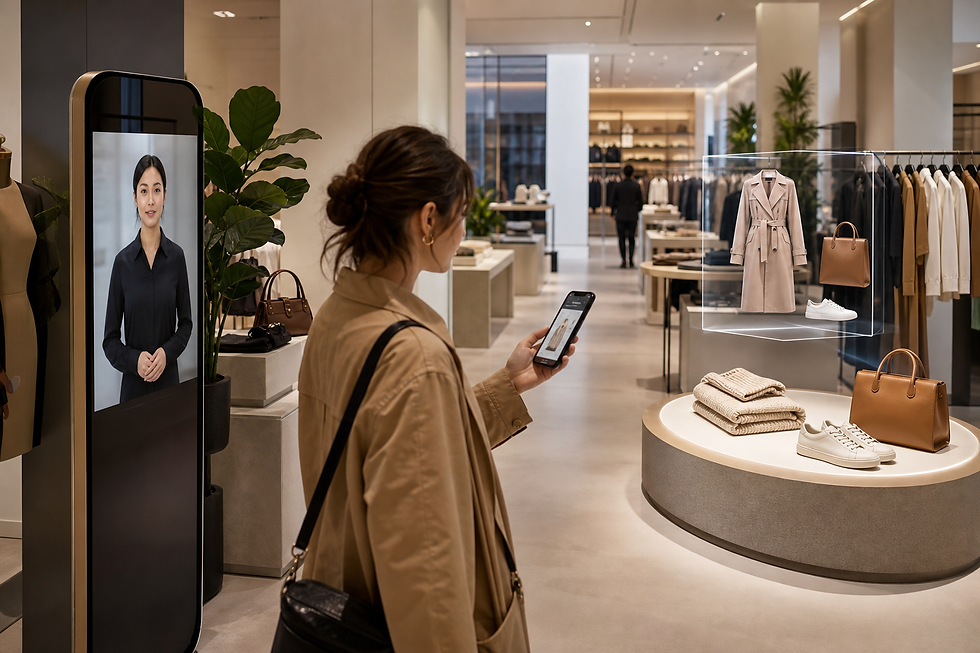
What happens when retail AI, 3D product experiences, virtual stores, and store operations finally work as one journey?
Retail experience orchestration is the practice of connecting every digital and physical retail touchpoint so shoppers can move from inspiration to product confidence without losing context. It brings together AI shopping assistants, 3D product visualization, virtual stores, real-time inventory, shopper analytics, and human service into a single operating model.
For Mimic Retail, this is where immersive commerce becomes practical. A retailer should not have one disconnected project for visual search, another for virtual showrooms, another for AI avatars, and another for store dashboards. The better path is an orchestrated experience layer that lets each capability support the next decision in the customer journey.
Table of Contents
What retail experience orchestration means

Retail experience orchestration connects the customer-facing journey with the systems that support it. Instead of asking shoppers to restart every time they switch channel, the retailer preserves intent, product context, preferences, service history, and next-best actions across mobile, ecommerce, store displays, AI assistants, and associate tools.
A shopper might discover a product through visual search, explore it in a 3D viewer, ask an AI assistant for fit or compatibility guidance, check store availability, enter a virtual store, and then receive support from a human associate. Orchestration makes that path feel continuous. It also gives retail teams a better way to measure which touchpoints actually move customers forward.
This is why orchestration pairs naturally with Mimic Retail services. The goal is not to add isolated novelty features. The goal is to design retail systems where AI, spatial content, analytics, and operations behave like one useful experience.
Good orchestration is also practical for teams. It clarifies which data each touchpoint needs, what events should be measured, when an automated assistant should continue the journey, and when a human should take over. That makes the experience easier to improve because every capability is tied to a specific shopper decision.
Why disconnected retail technology fails shoppers

Many retail technology programs fail because each tool solves a narrow problem but ignores the next step. The product visualization tool cannot see inventory. The AI assistant cannot access merchandising context. The store display cannot remember what a shopper explored online. The analytics dashboard measures clicks but not confidence, hesitation, or handoff quality.
Shoppers do not think in systems. They think in tasks: find the right product, understand the difference, confirm fit, compare options, get help, and buy with confidence. When channels are disconnected, the burden shifts to the shopper. That leads to repeated questions, low trust in AI recommendations, unnecessary returns, and missed in-store service moments.
Orchestration is especially important in phygital retail experience design because physical and digital moments must reinforce each other. A store visit should improve digital personalization, and digital discovery should make the store visit more productive.
Disconnected tools also make it harder for retail teams to learn. If an immersive showroom improves confidence but the ecommerce platform cannot see that signal, the team may underinvest in the experience. If an associate resolves questions that AI could have prepared in advance, the team loses productivity. Orchestration closes those gaps.
How AI assistants coordinate the journey

An AI shopping assistant becomes more valuable when it acts as a journey coordinator rather than a scripted chatbot. It can interpret intent, ask clarifying questions, compare products, surface visual proof, trigger a 3D or AR view, check availability, and pass context to a store associate when human help would be faster or more reassuring.
The best assistants do not pretend to replace the whole retail experience. They reduce friction around discovery and decision-making. They can help a shopper understand why two products differ, what accessory completes a use case, whether an item is available nearby, or which product suits a budget, size, style, and delivery constraint.
This builds on the role of virtual shopping assistants for retail and extends it into store operations. When the assistant can coordinate with inventory, 3D assets, personalization rules, and human support, it becomes part of the retailer's operating model instead of a front-end experiment.
AI also makes orchestration more conversational. A shopper can begin with a vague need, refine it through questions, see visual options, and then receive a practical recommendation. The system should explain why the recommendation fits and which assumptions it used, especially when price, sizing, availability, or returns are involved.
Where 3D and virtual stores fit

3D product visualization and virtual stores give shoppers a way to inspect, compare, and imagine products before committing. But they work best when they are not floating experiences. They should connect to product data, inventory, pricing, recommendations, service rules, analytics, and AI guidance.
In an orchestrated journey, a shopper can move from a product page into a spatial showroom, compare variants, ask an AI assistant why one option fits better, view related products, save a room or outfit, and continue the journey in store. The virtual environment becomes a decision space, not a detached brand moment.
Retailers can use 3D product visualization in retail as a reusable asset foundation. The same models can support ecommerce, AR try-on, virtual stores, retail media, sales enablement, and customer support when metadata and performance tracking are planned from the start.
This also strengthens retail digital twins and 3D virtual stores. A digital twin becomes more useful when it is tied to campaign planning, assortment testing, store training, shopper behavior, and the operational data needed to make the virtual environment truthful.
Real-time store intelligence as the operating layer

Experience orchestration needs an operating layer that understands what is happening now. Real-time store intelligence connects product availability, shelf signals, staffing, queue pressure, campaign activity, shopper behavior, and digital engagement. Without that layer, AI guidance and immersive content can recommend a next step the store cannot fulfill.
For example, a virtual assistant should know when an item is out of stock in a nearby store, when a product is trending after a campaign, or when a shopper's online interest should trigger an associate prompt. A virtual store should show realistic availability and offers. A dashboard should connect experience data with operations, not just page views.
This connects directly to smart retail solutions for real-time store intelligence. The more reliable the operating layer, the more confidently retailers can automate guidance, personalize journeys, and support store teams.
Store intelligence also protects the customer experience from overpromising. If AI, AR, or a virtual showroom is not grounded in current operational truth, the shopper may be impressed at first and disappointed later. Orchestration keeps the promise realistic from discovery through fulfillment.
Roadmap, metrics, and responsible AI

Retailers do not need to orchestrate everything at once. The strongest roadmap starts with one high-value journey, then expands as teams learn what data, assets, and operational handoffs are required. A focused pilot is usually better than a broad launch that looks impressive but cannot be measured.
Map the journey: choose one shopper task, such as visual discovery, virtual consultation, product comparison, or store pickup support.
Audit the foundation: product data, inventory signals, media assets, 3D files, customer permissions, analytics events, and store workflows.
Design the handoffs: decide when AI handles the next step, when a 3D or AR view helps, and when a person should enter the experience.
Measure behavior: track discovery quality, confidence signals, assisted conversion, handoff success, and operational friction.
A roadmap like this also supports agentic AI shopping journeys because autonomous assistance depends on clear permissions, accurate data, and well-defined actions. The AI can only coordinate the journey if the retailer has designed what coordination means.
Orchestration should be measured by journey outcomes, not feature usage alone. Track assistant resolution rate, 3D engagement depth, store handoff acceptance, product confidence signals, add-to-cart rate, return reduction, inventory-related friction, and associate time saved. The point is to understand whether the system helped the shopper make a better decision.
Governance matters because orchestration can combine personal preferences, behavioral data, camera input, location, inventory, and AI-generated guidance. Retailers should define consent rules, retention policies, escalation paths, content approvals, and human review. AI should be transparent about uncertainty and should never invent product, pricing, policy, or availability claims.
The same discipline improves personalized shopping experiences because shoppers are more likely to accept personalization when it feels explainable, useful, and under their control.
FAQ
What is retail experience orchestration?
Retail experience orchestration connects digital and physical touchpoints so shoppers can move across AI assistance, ecommerce, 3D product views, virtual stores, real-time inventory, and human support without losing context.
How is orchestration different from omnichannel retail?
Omnichannel retail focuses on being present across channels. Orchestration focuses on making those channels work together around a shopper's intent, data, product context, and next-best action.
Why do AI shopping assistants need orchestration?
AI assistants need accurate product data, inventory, shopper permissions, visual assets, store rules, and human handoff paths. Without orchestration, the assistant can answer questions but cannot reliably coordinate the journey.
Where do 3D virtual stores fit in an orchestrated journey?
3D virtual stores create spatial discovery and product confidence. In an orchestrated journey, they connect to recommendations, inventory, AI guidance, analytics, and store support rather than acting as standalone brand experiences.
What data does retail experience orchestration require?
Retailers need clean product data, media assets, 3D models, inventory and availability signals, customer permissions, behavioral events, service rules, store workflows, and analytics definitions.
Can orchestration improve store associate productivity?
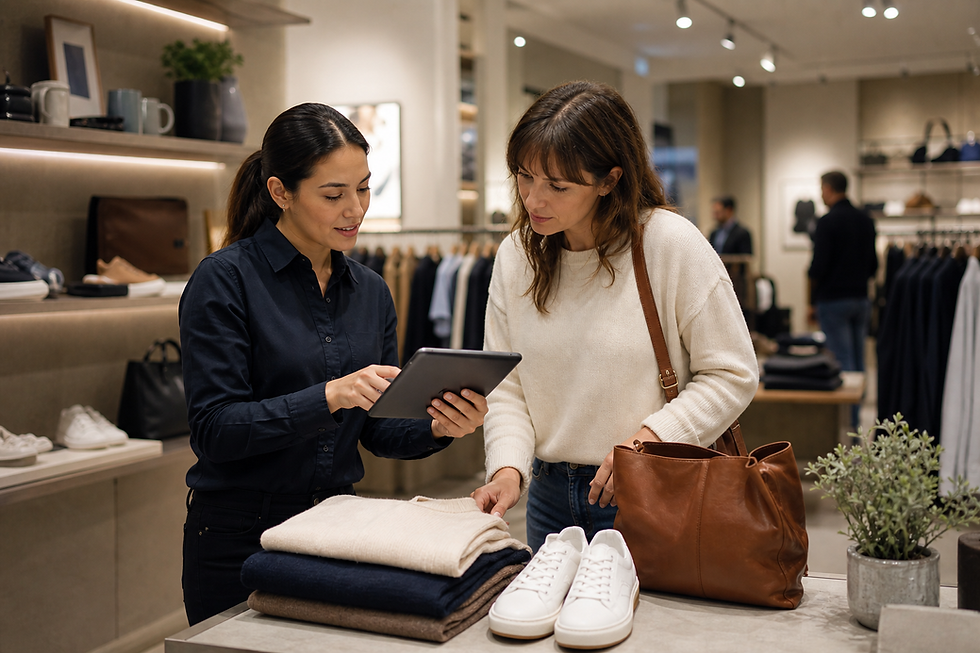
Yes. When AI and digital touchpoints preserve context, associates can see what the shopper has explored, what questions remain, and which product or service action is most useful.
Which metrics should retailers track first?
Start with journey completion, assisted conversion, product confidence signals, handoff success, no-result rates, engagement with 3D or AR proof, inventory accuracy, return reasons, and associate time saved.
How can retailers keep orchestration privacy-conscious?
Use clear consent, minimize data collection, explain image and behavioral data use, avoid sensitive inference, provide opt-outs, set retention limits, and keep human review available for high-impact decisions.
Conclusion
Retail experience orchestration turns separate innovation projects into one measurable customer journey. AI assistants, 3D product visualization, virtual stores, real-time intelligence, visual search, and store teams all become more useful when they share context and support the same shopper task.
The retailers that win with immersive commerce will not simply add more interfaces. They will design systems where each interface knows what the shopper is trying to do, what the operation can support, and when human service should step in.
Mimic Retail helps brands build AI-powered, immersive retail experiences that connect virtual stores, 3D assets, customer guidance, and real-time intelligence. Explore Mimic Retail services or contact the team to plan an experience layer shoppers can trust and teams can measure.


Comments