Personalized shopping experience vs recommendation engines

Most retail teams talk about personalization as if it were a single feature. In practice, shoppers feel “personal” when the entire journey responds to them. That includes product discovery, guidance, confidence-building, and the way a brand shows up across store, site, and mobile.
A recommendation widget can lift a basket. But it rarely carries the full weight of decision support. If you want a personalized shopping experience that actually feels designed, you need more than “people like you also bought.” You need a journey that blends logic, context, and interaction, including experiences like AI-guided assistance, immersive product exploration, and measurable engagement.
At Mimic Retail, we build retail experiences using immersive 3D and AI-driven avatars across advertising, virtual retail, AR, XR activations, and analytics. This article breaks down where recommendation engines shine, where they fall short, and how to design the layer above them so the shopper feels understood. Explore the building blocks in our retail experience work on our services page.
Table of Contents
Where recommendation engines fit in the shopper journey?
A good recommender is a powerful ingredient. It can help shoppers discover products faster, reduce “scroll fatigue,” and increase cross-sell without turning the site into a maze. But it is still an ingredient, not the meal.
The common pattern is that teams deploy recommendation engines and then label the result “personalization.” Shoppers often do not agree. They judge personalization by how helpful the experience is in the moment, not by whether the algorithm is “smart.”
Here is where recommendation engines typically deliver the most value.
Relevance: Fast discovery of adjacent products, substitutes, and accessories based on behavior signals and merchandising inputs.
Scale: Automated product-to-product relationships across large catalogs where manual curation cannot keep up.
Recency: Session-based suggestions that respond to what a shopper is doing right now, not only what they did last month.
Efficiency: Lightweight deployment in e-commerce stacks where teams need wins without rebuilding the entire journey.
Guardrails: A controlled layer where merchandising rules can block low-margin pairings, out-of-stock items, or brand conflicts.
Where it usually breaks down is not accuracy. It is experience design. Many recommenders are delivered as small rectangles on a page, disconnected from the shopper’s real question: “Is this right for me?”
The gap shows up most clearly in four scenarios:
High-consideration products where fit, use-case, and uncertainty matter more than similarity.
New shoppers and new products, where cold start makes behavioral signals thin.
Omnichannel journeys where the store, mobile, and site need to feel coherent.
Moments where the shopper wants guidance, not suggestions.
That is where a personalized shopping experience moves from “recommended items” to “supported decisions.”
A lot of what follows depends on the stack behind the scenes, especially how you connect data, 3D content, and real-time interaction. Here is a useful primer on our technology approach.
What actually makes a personalized shopping experience feel personal?
A personalized shopping experience is not a single algorithm. It is a layered system that makes the shopper feel seen, without being creepy, and without forcing them to do extra work.
Think in layers. Each layer can be powered by recommendation engines, but the shopper experiences it as one continuous flow.
Layer 1. Context and intent
Personal starts with context. Not every shopper wants the “best” product. They want the best product for their situation.
Signals that matter in retail:
Device and environment (in-store, at home, on commute)
Time sensitivity (gift deadline, event date, seasonal need)
Budget range and brand affinity
Size, fit, and compatibility constraints
Exploration mode vs decision mode
This is where teams often add a virtual shopping assistant rather than more tiles. When the shopper can ask “What is the difference?” the experience shifts from recommendation to guidance. In conversational commerce, the interface becomes the personalization layer.
If you want to see how this plays out across channels, this breakdown is useful: how an AI shopping assistant improves omnichannel shopping experiences.
Layer 2. Interaction design, not just prediction
Shoppers trust what they can inspect. That is why immersive experiences punch above their weight. The more clearly a shopper can understand a product, the more “personal” the journey feels, because it respects their decision process.
This is where virtual store environments and a 3D retail simulation approach can change the feeling of browsing. Instead of infinite scroll, you give a usable layout, familiar navigation cues, and discovery that feels intentional across desktop, mobile, and VR.
Navigation: A 3D environment can group products the way store teams actually merchandise, which makes exploration feel human.
Discovery: Visual browsing supports taste-driven categories where keywords fail.
Assurance: Seeing scale, texture, and context reduces uncertainty that recommendations cannot fix.
Layer 3. Confidence tools that reduce doubt
In categories like fashion, beauty, accessories, and even home goods, confidence is the conversion lever. That is where AR product visualization and virtual try-on stop being “nice to have” and become part of personalization.
When fit and finish are the blocker, personalized means:
The product looks right on me.
The color reads right in my lighting.
The scale makes sense in my space.
The material behaves as expected.
This is also where returns reduction becomes a practical KPI. A journey that helps the shopper feel certain is a better personalization story than another “recommended for you” row.
For a deeper look at confidence-driven shopping, here is a relevant perspective: why virtual reality shopping reduces product returns and uncertainty.
Layer 4. Assistance that feels present, not generic
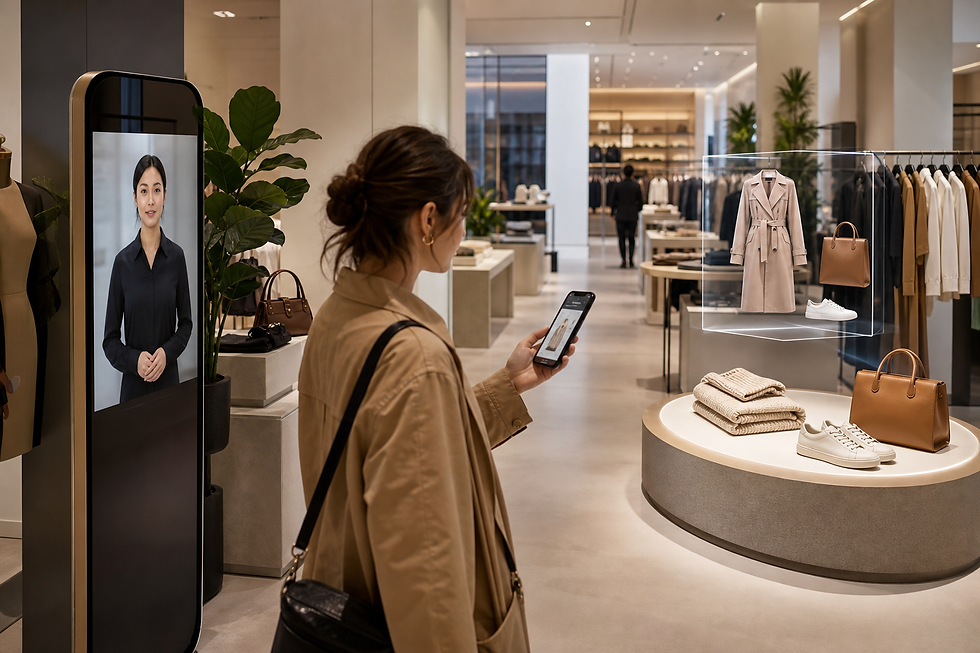
A personalized shopping experience often needs a “helper” layer that can respond in real time. That is where AI avatars for retail become useful, especially when they are designed as retail staff, not as chatbots.
A well-designed avatar layer can:
Answer product questions with brand-specific constraints
Compare options in plain language
Recommend based on stated intent, not only click history
Support store teams with consistent product storytelling
Bridge online-to-store with the same voice and logic
Under the hood, this is typically powered by NLP, sometimes paired with computer vision for contextual understanding, plus interaction tuning that avoids robotic phrasing.
In some deployments, emotion recognition is used carefully to detect frustration signals and escalate help, not to “profile” the shopper.
Layer 5. Measurement that proves experience value
Personalization without measurement becomes opinion. A modern system uses retail engagement analytics to track how shoppers interact, not only what they buy.
What teams should measure beyond conversion:
Dwell time around key categories and hero products
Interaction depth (how far shoppers go into a 3D experience)
Drop-off points in comparison and fit-check flows
Assisted vs unassisted performance (where help changes outcomes)
Path consistency across channels using omnichannel dashboards
If you want a store-side view of measurement, this is a helpful read: smart retail solutions for real-time store intelligence.

Comparison of personalization vs recommendation engines across retail touchpoints
Retail touchpoint | Personalized shopping experience approach | Recommendation engines approach | How Mimic Retail supports it |
Homepage and landing | Starts with intent cues, guided entry points, and adaptive pathways | Populates “recommended” rails and personalized rankings | Journey design that blends assistance, merchandising logic, and immersive entry points |
Category browsing | Uses layout, visual exploration, and interactive discovery | Suggests related items and reorders lists | virtual store and 3D retail simulation concepts that make navigation feel like retail |
Product detail page | Builds confidence with comparison, explainers, and fit support | Adds “similar items” and “complete the look” | AI avatars for retail + AR product visualization patterns for decision support |
In-store assist | Extends knowledge and guidance to floor teams and shoppers | Limited unless integrated with POS or app | Avatar-led guidance and analytics-linked activations via XR integration |
Promotions and retail media | Adapts creative by audience context and interaction | Targets based on segments and predicted affinity | Retail advertising built for dwell time and interaction, not only impressions |
New products and cold start | Uses guided questions, style inputs, and visual exploration | Struggles without behavior history | virtual shopping assistant flows and experience-led discovery |
Measurement | Tracks engagement and decision support, not just sales | Tracks clicks, views, and attributed revenue | retail engagement analytics with omnichannel dashboards |
Applications In Retail
A personalized shopping experience becomes real when you map it to moments that teams can build, deploy, and measure.
Guided selling: A virtual shopping assistant that asks 2 to 4 smart questions and narrows the aisle like a great associate.
3D discovery: A virtual store experience that mirrors store merchandising so shoppers can browse by feel, not only filters.
Fit confidence: virtual try-on supported by AR product visualization to help shoppers validate color, texture, and styling.
Avatar concierge: AI avatars for retail that handle FAQs, compare options, and provide real-time support during peak traffic.
Immersive launches: XR activations for new drops that blend storytelling with interaction, including holographic moments and mixed reality pop-ups.
Experience reporting: Dashboards that combine dwell time, interaction depth, and conversion signals using omnichannel dashboards.
Team enablement: Store and e-commerce teams aligned through one set of product narratives and one measurement layer.
If you want to understand the studio behind these builds, see how we work on our about us page.
Benefits
When retail teams design above the algorithm, the journey becomes more useful to shoppers and more manageable internally.
Clarity: Shoppers understand what to buy and why, which reduces comparison paralysis.
Confidence: AR product visualization and virtual try-on can reduce uncertainty that drives hesitation and returns.
Continuity: Cross-channel consistency improves when omnichannel dashboards reflect the same journey logic in every touchpoint.
Engagement: Immersive discovery and assisted guidance can increase dwell time and interaction depth in measurable ways.
Control: Merchandising teams can combine rules with recommendation engines instead of surrendering the experience to black-box rankings.
Support: AI avatars for retail provide scalable help without forcing shoppers into ticket-style customer service.
Considerations For Retail Teams
A personalized shopping experience is a capability. Treat it like a product, not a plug-in.
These are the realities that determine whether it lands.
Data readiness: First-party data, consent, and taxonomy quality matter more than model choice. Garbage tags create garbage “personalization.”
Content operations: 3D assets, scripts, product knowledge, and creative variants need owners and a publishing rhythm.
Governance: Define what your assistant can say, when it escalates, and how brand claims are checked before launch.
Experiment design: Measure assisted journeys vs control journeys, and track interaction depth, not only last-click revenue.
Channel alignment: Store teams, e-commerce, and retail media need shared definitions of intent and success metrics.
Performance: Immersive builds must load fast on mobile. Optimize asset weight, streaming, and real-time rendering budgets.
Privacy posture: If using emotion recognition or vision signals, be transparent and conservative. Use it to improve help, not to label people.
Future Outlook
The next phase is not “better recommendations.” It is retail experiences that behave like great staff and great stores, delivered through screens and spaces.
You will see four shifts accelerate:
AI-led assistance becomes the interface: Shoppers will increasingly navigate via conversational commerce, with a virtual shopping assistant that can compare, explain, and personalize in real time.
Virtual retail becomes a usable channel: virtual store design will mature from novelty into a practical way to browse complex assortments, especially with photoreal environments built from 3D scanning and optimized for everyday devices.
Try-on and visualization become default: AR product visualization and virtual try-on will be expected in fit-sensitive categories, framed as confidence tools and a practical lever for returns reduction.
Measurement becomes experience-native: retail engagement analytics will track dwell time, interaction depth, and assisted outcomes across channels, surfaced through omnichannel dashboards that teams can actually act on.
Behind the scenes, the enabling stack will keep converging. NLP for dialogue, computer vision for context, motion capture for lifelike performance, and XR integration that connects digital layers to real retail environments.

Conclusion
If you treat recommendation engines as personalization, you end up with a familiar outcome: more rows, more noise, and a shopper who still feels on their own. If you design the journey above the algorithm, personalization becomes tangible. It becomes guidance, confidence, and continuity across channels.
A strong personalized shopping experience uses recommendations, but it does not stop there. It uses immersive discovery through 3D retail, it supports decision-making through assistance, it reduces uncertainty through visualization and try-on, and it proves value through measurable engagement.
That is the lane Mimic Retail is built for. We combine creative experience design with the technical stack required to deploy AI, 3D, AR, and XR in ways retail teams can operate and measure.
FAQs
What is the difference between a personalized shopping experience and recommendation engines?
Recommendation engines predict what a shopper might want next. A personalized shopping experience designs the whole journey to respond to intent, context, and confidence needs, including guidance and interactive tools.
Are recommendation engines enough for high-consideration categories?
Often no. For products where fit, compatibility, or quality perception matters, shoppers need explainers, comparisons, and confidence tools like AR product visualization or virtual try-on, not only similar-item suggestions.
How do AI avatars for retail improve personalization without feeling intrusive?
They work best when they behave like skilled staff. They ask a small number of intent questions, explain tradeoffs, and keep control with the shopper. The goal is real-time support, not profiling.
What role does a virtual store play in personalization?
A virtual store makes discovery feel intentional by using layout and visual browsing. It supports taste-led navigation and can mirror real merchandising, which can feel more personal than filter-based browsing.
What should we measure to prove personalization is working?
Go beyond conversion. Use retail engagement analytics to track dwell time, interaction depth, assisted vs unassisted outcomes, and drop-off points. Roll it up in omnichannel dashboards so teams can act.
How do you handle cold start problems in recommendation engines?
Blend predictions with guided questions, merchandising rules, and interactive exploration. A virtual shopping assistant can capture intent quickly, which reduces reliance on historical behavior.
Does virtual try-on actually help reduce returns?
It can, when it is implemented for fit and texture confidence, and when the experience is tuned for mobile usability. Treat it as a decision-support layer, not a novelty.
What tech foundations matter most for these experiences?
A practical base includes NLP for dialogue, computer vision for contextual inputs when appropriate, optimized 3D pipelines using 3D scanning, lifelike performance via motion capture, and scalable delivery through real-time rendering and XR integration.


Comments