Virtual Shopping Assistant: AI Avatars for Retail

A virtual shopping assistant is becoming one of the most practical ways for retailers to make digital commerce feel guided, human, and measurable. Shoppers already expect quick answers, personal recommendations, and confidence before they buy. The challenge is delivering that help without forcing every customer into a generic chat window or overloading store teams.
For Mimic Retail, the opportunity is not only automation. It is experience design. A strong assistant can combine product knowledge, visual interaction, AI avatars, 3D product context, and analytics so shoppers feel supported from first question to final decision.
This guide explains where virtual shopping assistants fit, how they work, what retailers should measure, and how to launch one without turning the experience into another disconnected tool.
Table of Contents
What is a virtual shopping assistant?
A virtual shopping assistant is a digital guide that helps shoppers choose products, understand options, compare details, and move through a purchase journey with less uncertainty. It can appear as a chat interface, voice-led assistant, AI avatar, in-store kiosk, mobile companion, or guided layer inside a virtual store.
The best versions do more than answer FAQs. They interpret shopper intent, apply visible filters, explain trade-offs, recommend next steps, and hand off to a human when the question needs judgement. In that sense, a virtual shopping assistant sits between ecommerce search, customer service, product education, and conversion design.
Mimic Retail builds these experiences as part of broader retail experience services, connecting AI, immersive 3D, AR, XR activations, and measurement so the assistant is not isolated from the rest of the shopper journey.
Why retailers are investing now
Retail teams are under pressure to make every channel work harder. Acquisition costs are high, shoppers compare options quickly, and product pages often fail to answer the questions that determine whether someone buys. A virtual shopping assistant helps close that gap by giving customers useful guidance at the moment they need it.
The commercial case is strongest when the product has choice complexity: fit, size, compatibility, style, material, configuration, or availability. These are the moments where static product cards and recommendation widgets start to feel thin. A guided assistant can ask what matters, narrow the field, and explain why a recommendation fits.
This is also why assistants pair naturally with virtual try on technology and other immersive tools. The assistant answers the question, then helps the shopper validate the decision visually.

Retail use cases that create value
A virtual shopping assistant should start with a clear job. If the job is too broad, the assistant becomes vague. If the job is specific, it can improve conversion, support, and insight at the same time.
Guided product discovery: help shoppers move from need to shortlist, especially in categories with many variants.
Sizing and fit support: explain measurements, compare fit preferences, and route shoppers into AR try-on when available.
In-store navigation: help customers find products, check availability, or understand promotions before staff intervention is needed.
Assisted checkout: answer delivery, returns, and compatibility questions without disrupting payment confidence.
Product education: explain materials, features, sustainability claims, and care instructions in language shoppers understand.
For immersive commerce, the assistant should work alongside the interface rather than replace it. In Mimic Retail's virtual shopping experience UX checklist, filters, cart stability, AR try-on, and checkout are treated as one journey. The assistant should respect that same logic.
How AI avatars make assistance feel more human
AI avatars can turn a virtual shopping assistant from a utility into a branded experience. The value is not that an avatar looks futuristic. The value is that it can make guidance feel present, consistent, and easier to follow across channels.
A strong retail avatar has a defined role. It may be a product expert, style advisor, store guide, training host, or campaign character. The visual design, motion, voice, and response style should all support that role. Generic avatars create novelty; brand-specific avatars create recognition.
The underlying Mimic Retail technology stack matters here: real-time rendering, motion capture, 3D scanning, analytics, and AI orchestration all influence whether the assistant feels believable or clunky.

Implementation checklist for retail teams
The safest way to launch is to start narrow, prove value, and expand. Retail assistants fail when teams try to answer every possible question on day one. They succeed when they solve one high-friction journey very well.
Pick the journey: discovery, sizing, availability, service support, store navigation, or checkout recovery.
Define the knowledge base: product data, policies, store information, campaign rules, and escalation paths.
Design the assistant role: tone, visual identity, avatar behavior, and boundaries for what it can do.
Connect visible actions: when the assistant applies a filter or recommends a product, show the shopper what changed.
Instrument events: measure questions asked, products compared, try-on usage, handoffs, carts, and completed orders.
Plan the human handoff: every assistant needs a clear route to staff, support, or sales when automation is not enough.
This operational discipline is similar to artificial intelligence in retail stores: the assistant should reduce noise, clarify the next step, and make the outcome measurable.
Measurement, governance, and trust
A virtual shopping assistant is only useful if customers trust it and retailers can learn from it. That means the experience needs transparent recommendations, clean analytics, and clear governance around data, privacy, and escalation.
Measure more than chatbot usage. Track assistant-start rate, completed guided journeys, product shortlist depth, conversion after assistance, handoff rate, unresolved questions, return reasons, and satisfaction. Pair those metrics with AI Shopping Assistants category content and future posts so the blog cluster continues to answer search intent around guided retail.
Trust also depends on restraint. The assistant should not invent policy details, hide sponsored logic, or force decisions. It should explain recommendations in plain language and make user controls visible. When shoppers can see and reverse an action, assistance feels helpful rather than manipulative.
For teams exploring broader immersive strategy, the Immersive Shopping category connects assistant design with AR, virtual try-on, and 3D retail experience planning.
FAQ
What is a virtual shopping assistant?
It is a digital assistant that guides shoppers through product discovery, comparison, questions, and purchase decisions. It can appear as chat, voice, an AI avatar, an in-store kiosk, or a guided layer inside a virtual store.
How is it different from a recommendation engine?
A recommendation engine suggests products. A virtual shopping assistant can ask questions, explain trade-offs, apply visible filters, connect to try-on tools, and escalate to a human when needed.
Do AI avatars improve conversion?
They can, when they reduce uncertainty and support a clear shopper task. The avatar itself is not the conversion driver; the quality of guidance, timing, product data, and user experience is.
Which retail categories benefit most?
Fashion, beauty, furniture, electronics, sporting goods, and other choice-heavy categories benefit because shoppers need help with fit, style, compatibility, size, or configuration.
Can a virtual shopping assistant work in stores?
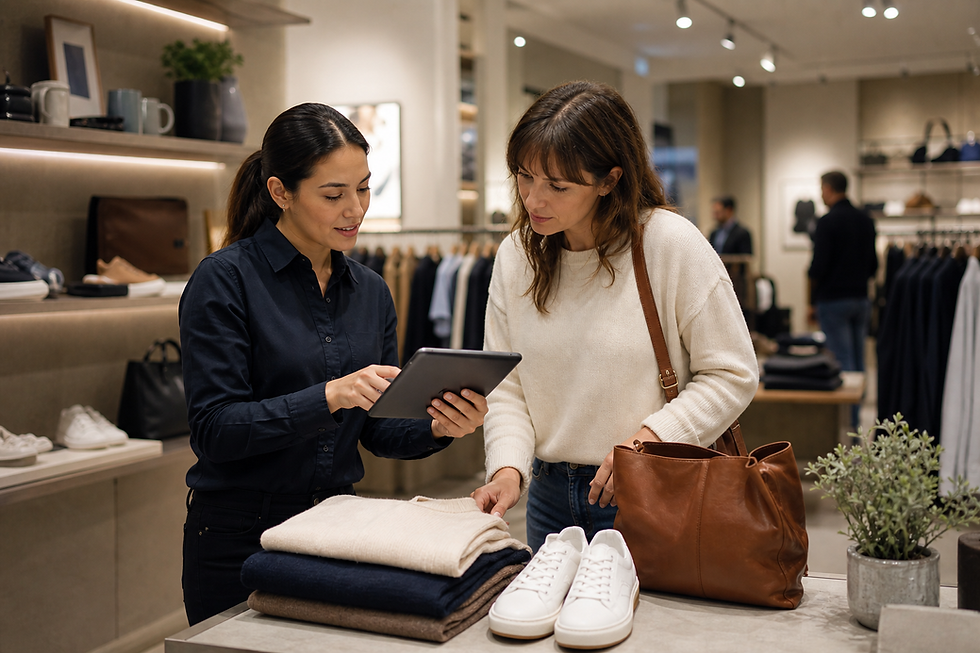
Yes. It can run on kiosks, tablets, smart displays, mobile web, or staff-assisted devices to answer questions, locate products, support service teams, and guide shoppers through ranges not fully stocked on the floor.
What data does an assistant need?
It needs structured product data, availability, policies, content rules, journey goals, and escalation paths. Better assistants also connect to analytics so teams can improve answers and product journeys over time.
Should an assistant replace human staff?
No. The stronger model is support and escalation. The assistant handles repeatable questions and guided discovery, while staff focus on nuanced service, complex decisions, and higher-value interactions.
How should retailers measure success?
Track guided journey completion, product comparisons, assisted conversion, average order value, handoff rate, unresolved questions, return reasons, and customer satisfaction. The goal is measurable confidence, not just chat volume.
Conclusion
A virtual shopping assistant works when it behaves like a good retail guide: useful, specific, transparent, and easy to trust. AI avatars can make that guidance feel more human, but the strategy depends on product data, UX discipline, immersive content, and measurement.
Mimic Retail builds virtual shopping assistants, AI avatar experiences, immersive retail environments, and AR product visualisation for brands that want shopper guidance to feel as polished as the rest of their retail experience. Explore Mimic Retail's services or learn more about the studio to plan a guided retail experience that shoppers can actually use.


Comments