Artificial Intelligence in Retail Stores for Staff Productivity and Task Automation

The store floor is full of micro decisions. Which aisle needs replenishment first? Which promo is not signed correctly? Which associate is free to support a customer? Most retailers still run this reality on radios, walkie-talkies, and tribal knowledge. It works until it does not. Peak hours, staff turnover, and fragmented systems turn basic execution into daily firefighting.
This is where artificial intelligence in retail stores becomes practical. Not as a replacement for store teams, but as a layer that watches, suggests, and automates the parts of the job that drain time. When it is designed correctly, it improves retail staff productivity by reducing context switching and giving associates a clear, prioritized task path.
At Mimic Retail, we build immersive retail experiences that pair AI avatars, virtual stores, and measurement-ready interaction design. The same discipline applies to store operations. Make tasks visible, make decisions explainable, and make the outcome measurable. If you want to see how this connects to our delivery model, start with our retail experience services.
Table of Contents
Where does artificial intelligence fit in day-to-day store operations?
Store work is not one big problem. It is dozens of small tasks that compete for attention. The best use of artificial intelligence in retail stores is to reduce the noise and make “next best action” feel obvious.
A helpful way to map the opportunity is to separate store activity into three lanes: sense, decide, act.
Sense: Capture signals across the floor and backroom, then translate them into store-ready prompts. This is where computer vision and in-store analytics add value, especially when teams cannot manually audit everything.
Decide: Rank what matters now. This is the heart of task orchestration and workforce optimization, because not every exception deserves the same urgency.
Act: Trigger a task, log a completion, or automate part of the workflow. This is where store task automation becomes real, not theoretical.
Examples of store moments that benefit from this approach:

Promo execution: Detect missing signage or misplaced endcaps, then route a fix task to the right zone owner.
Shelf availability: Flag likely gaps, then push a replenishment task with the most probable backroom location.
Service support: Reduce friction at the moment a shopper needs help through an AI shopping assistant that can answer questions, locate products, and escalate to staff when required.
Compliance checks: Convert recurring audits into guided tasks that reduce time spent on documentation.
For Mimic Retail, the goal is not automation for its own sake. It is a store experience where teams spend more time with shoppers, and less time hunting for what to do next.
For the technical building blocks behind automation and measurement, explore the Mimic Retail tech stack.
A practical workflow for task automation that staff actually use

The difference between a good automation program and shelfware is usually operational, not technical. If store teams do not trust the tasks, the system becomes another tab to ignore. A workable rollout follows a simple sequence.
Start with a single task family, then expand once the store believes it.
Define “done” in store language: “Complete replenishment” is vague. “Face the top shelf, fill to three facings, confirm size run, photo check” is actionable. This is associate enablement in its simplest form.
Create a signal you can explain: If you use computer vision, be clear about what it is detecting. If the signal comes from sales, inventory, or traffic patterns, show the reason in one sentence. Explainability improves adoption and reduces “false alarm fatigue”.
Build a priority model that matches store reality: A perfect algorithm that sends tasks in the wrong order will be hated. Tie priority to store rhythms: opening, lunchtime, after-work rush, closing. This is where workforce optimization and task orchestration stop being abstract.
Make the task path short: A task that takes six taps will not survive Saturday. Keep the flow tight: task, context, action, confirm. When possible, the system should pre-fill fields and recommend the next task.
Close the loop with measurement: If you cannot show the store that the workload got lighter, you will lose the team. Track completion time, rework rate, and exceptions per hour. Tie results to dwell time tracking and service metrics when customer-facing processes are involved.
Scale with a content operation, not a one-off project: Automation depends on fresh rules, updated planograms, and seasonal task packs. Treat it like retail content. Plan cadence, ownership, and governance as part of store operations automation.
This is also where immersive tools help. Training a new workflow inside virtual stores can reduce onboarding time and let staff rehearse exceptions without disrupting live trading.
Manual execution vs automated store operations
Store workflow area | Manual approach | Automated approach | What you measure | What Mimic Retail builds |
Replenishment and gaps | Walk aisles, spot-check shelves | Signal-led tasks routed by zone | Task time, out-of-stock exceptions | Task orchestration, mobile task flows |
Promo and signage | Visual checks by supervisors | Detection plus task routing | Rework rate, compliance frequency | In-store analytics, content QA loops |
Planogram accuracy | Periodic audits | Continuous prompts and guided fixes | Planogram compliance, time-to-fix | Guided audits and confirmation steps |
Service support | Associates search info manually | AI shopping assistant answers, escalates | Resolution time, handoff quality | AI avatars for customer-facing support |
Training and onboarding | Shadowing, paper checklists | Practice inside virtual stores | Confidence scores, ramp time | 3D simulation and task rehearsal |
Returns drivers | Reactive troubleshooting | Inventory accuracy plus better product guidance | Return reasons, mis-picks | AR try-on and richer product context |
Event activations | Ad hoc coordination | Pre-built playbooks and interactive moments | Engagement, queue flow | XR events with measurable interactions |
Applications In Retail

Once you pick a few task families and instrument them properly, automation becomes a flywheel. Stores get cleaner data, tasks get smarter, and managers get time back.
Opening readiness: Automate checklists into timed task waves so teams start trading faster and more consistently. This is a direct win for retail staff productivity.
Replenishment targeting: Prioritize top-selling gaps and route tasks based on location ownership to support store task automation without chaos.
Price and label integrity: Prompt fixes before issues compound at checkout, using real time store intelligence rather than weekly audits.
Audit-light visual standards: Maintain planogram compliance with guided checks that reduce supervisor laps.
Service escalation: Add an AI shopping assistant that covers FAQs and store navigation, then hands off to staff for complex needs.
Experience measurement: Use omnichannel dashboards to connect task execution to shopper outcomes, not just completion counts.
Store intelligence layer: If you want a broader view of how stores capture and act on signals, Mimic Retail breaks it down in our guide to smart retail solutions for real time store intelligence.
Benefits
The most valuable gains show up as fewer interruptions and fewer preventable mistakes. Over time, that changes the feel of the store. It becomes calmer, more responsive, and easier to run.
Cleaner prioritization: task orchestration reduces the “everything is urgent” problem that burns managers out.
More selling time: Better store task automation means associates spend less time searching for tasks and more time helping shoppers.
Lower rework: Stronger planogram compliance and clearer task definitions reduce repeat fixes.
Faster onboarding: associate enablement improves when training is supported by virtual stores and simulation-based practice.
Better availability: Improved inventory accuracy reduces phantom stock and wasted backroom hunts.
Smoother peaks: queue management guidance helps redeploy staff before lines become a problem.
Proof you can show: Pairing execution with conversion uplift measurement and dwell time tracking turns automation into a measurable program, not a vibes project.
Considerations For Retail Teams
Automation changes work. That means you need to design for people, not just systems.
Ownership model: Define who maintains task rules, priority logic, and seasonal playbooks so store operations automation stays current.
Data hygiene: Poor item location data will undermine real time store intelligence fast. Fix foundations before you scale signals.
Change management: Store trust is earned. Pilot with one region, fix friction, then expand with champions.
Exception handling: Every task needs a “cannot complete” path with reasons that improve the signal over time.
Measurement discipline: Decide which KPIs matter. Avoid vanity metrics and connect execution to in store analytics outcomes.
Experience design: If staff UI feels clunky, usage will drop. Design flows like retail UX, not enterprise software.
Privacy and governance: If you use cameras or advanced sensing, document what is captured, how it is used, and how teams are protected.
For Mimic Retail, this is also where immersive capability matters. If you are already investing in XR events, AR try-on, and AI avatars, unify governance so customer experience and store operations evolve together.
Future Outlook
The next wave of artificial intelligence in retail stores will feel less like “a tool” and more like a teammate. Not a gimmick, but a consistent layer that helps stores run.
Expect three shifts.
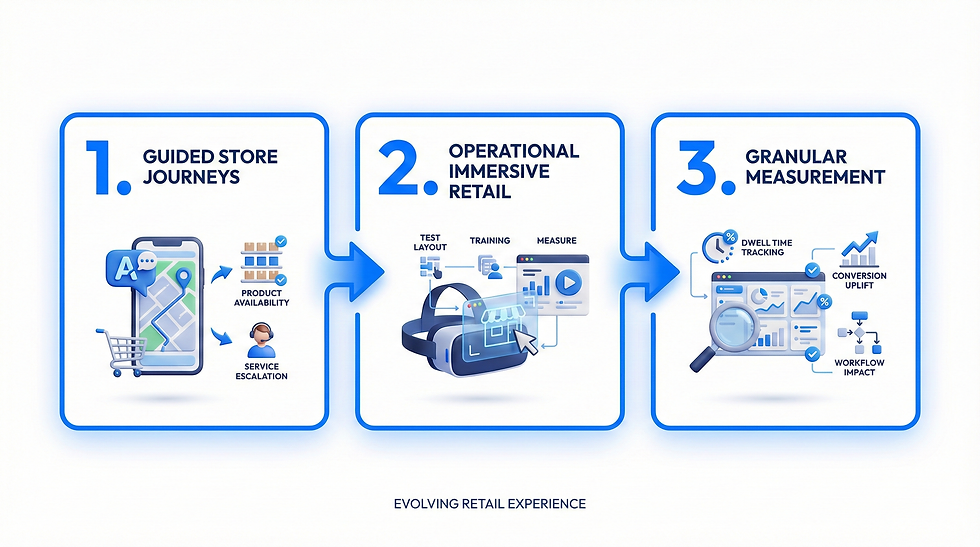
First, AI shopping assistant experiences will move beyond chat and into guided store journeys. Think product discovery, availability checks, and service escalation that reduce staff interruptions while keeping the human touch available.
Second, immersive retail will become operational, not just experiential. virtual stores will double as training grounds, merchandising sandboxes, and rollout simulators. Teams will test a layout or campaign before it hits the floor, then measure it through omnichannel dashboards.
Third, measurement will get more granular. Instead of weekly summaries, teams will look at interaction depth and workflow impact through dwell time tracking and better conversion uplift measurement tied to specific task changes.
If you want a shopper-facing lens on this trajectory, Mimic Retail’s breakdown of how an AI shopping assistant improves omnichannel shopping experiences connects the assistant layer to real retail journeys.
Under the hood, the pipeline will keep maturing. Retailers will blend natural language processing for intent, computer vision for environment awareness, and 3D pipelines using 3D scanning, motion capture, and real time rendering to keep experiences consistent across physical and digital touchpoints.
Conclusion
Store productivity does not come from squeezing more tasks into the day. It comes from removing the friction that makes simple work feel hard. When artificial intelligence in retail stores is applied to sensing, prioritization, and execution, teams regain time and confidence. That is the real ROI. A store that runs cleaner, serves shoppers better, and scales standards without exhausting the people who make the brand real.
Mimic Retail approaches this as experience design backed by a production-grade tech stack. We build the assistant layer, the immersive training environments, and the measurement framework so automation is usable on the floor and provable to leadership. If you are exploring store task automation and want it to feel natural for store teams, start with a practical scope and build from there.
FAQs
What is the best starting point for artificial intelligence in retail stores?
Start with one high-frequency task family like replenishment or promo compliance. You want clear definitions of done, a signal you can explain, and a workflow that reduces taps for staff.
How does store task automation avoid overwhelming associates?
It depends on good task orchestration. Prioritize based on store rhythms and workload capacity, then bundle tasks by zone so associates do not bounce across the floor.
Where does in-store analytics fit into staff productivity?
In-store analytics should feed tasks, not dashboards only. When analytics creates prioritized actions, it improves adoption and reduces time spent interpreting data.
Can an AI shopping assistant help in physical stores?
Yes, especially for repetitive questions like sizing, availability, and product features. The best setups handle quick answers and escalate gracefully to staff when nuance is needed.
How do you measure whether automation improved outcomes?
Track task completion time, rework rate, and exceptions per hour. Then connect this to shopper outcomes using dwell time tracking and conversion uplift measurement.
What does workforce optimization mean for store managers day to day?
It means smarter allocation, not headcount cuts. Predict where help is needed, shift coverage before problems appear, and reduce time lost to avoidable interruptions.
How do virtual stores support store operations?
They help teams practice workflows, test merchandising changes, and onboard new hires with realistic scenarios. This improves associate enablement without disrupting live trading.
What role do AI avatars play in productivity?
AI avatars can provide consistent customer support and guided help, which reduces interruptions to staff. They also support training and knowledge access when deployed with the right governance.


Comments